
Racine Epoxy Flooring coats basement floors with epoxy in Racine, WI, serving surrounding cities including Mount Pleasant, Sturtevant, Caledonia, Somers and Kenosha, and every one of those jobs starts with a moisture test rather than a color sample. After more than 20 years of basement work, we have learned that the floor you see is only half the story. The other half is the water in the soil under it.
A basement slab sits below grade with earth on every side, and in an older house it may have no vapor barrier at all. That does not rule out a coating, but it changes how the floor has to be built. Moisture testing is priced into our scope as a line item, so the reading is known before the job is sold rather than discovered when a coating blisters.
This page explains how we test and prepare a basement slab, when a coating is not the right answer, how we work around sump pits and drains, and the finishes that suit laundry rooms, workshops, gyms and family rooms.
Moisture Comes First in a Basement
Testing the Slab Before Quoting
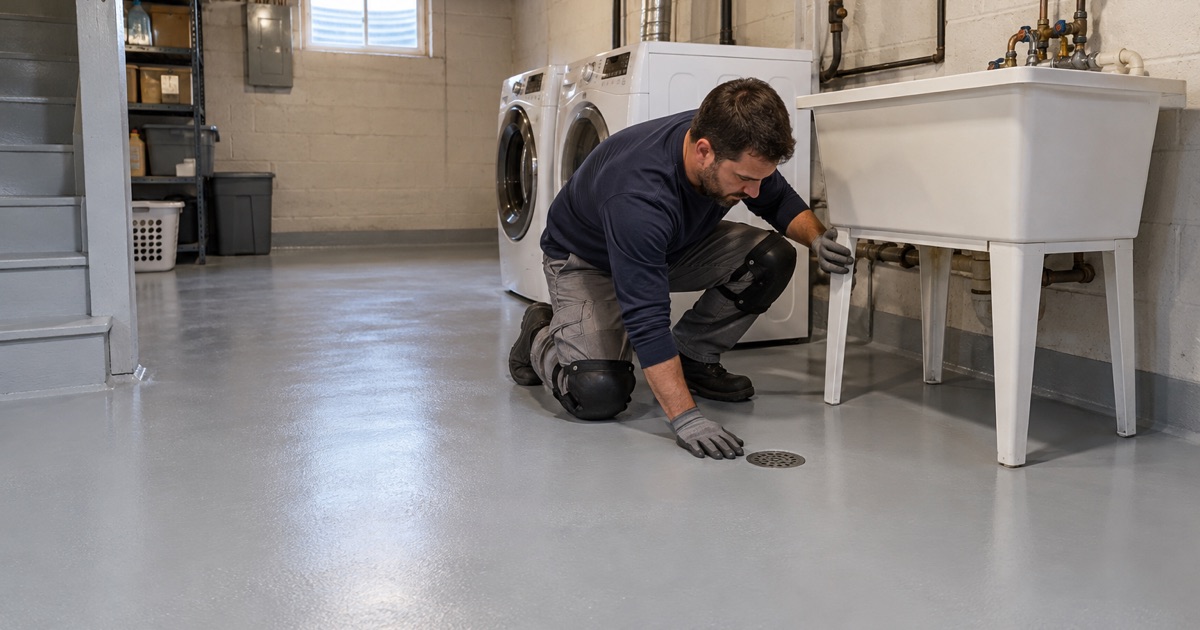
We choose the test to suit the floor. An ASTM D4263 plastic sheet test is a quick screen for whether moisture is reaching the surface. An ASTM F1869 calcium chloride test measures how much vapor the slab emits over a set period. ASTM F2170 probes, set into drilled holes, read the relative humidity inside the concrete itself.
The probe method tells us the most about a basement slab, because it reads below the surface where the coating’s bond will live. We compare the result with the limits on the product data sheet, and that comparison decides the primer. The reading and the decision both go in the proposal.
Moisture-Mitigation Primers
When a slab emits more vapor than a standard primer can tolerate, a moisture-mitigation primer goes down first. It is formulated to bond to damp concrete and slow vapor transmission, giving the epoxy above it a stable base.
It adds a step and a cost, so it appears as its own line rather than being buried in the price. A mitigation primer handles vapor, not liquid water or hydrostatic pressure, and we say so plainly when testing points to a problem it cannot solve.
Condensation Versus Rising Vapor
On humid summer days, warm basement air meets the cool slab and condenses on it, leaving the floor damp even though no water is coming up through the concrete. That is a timing and ventilation problem. We check the dew point spread at the slab surface and run dehumidification so the coating goes onto a dry surface.
Rising vapor is different: it comes from the soil and moves up through the slab year round. It is what the moisture tests are designed to catch. Telling the two apart is why we test rather than judge by eye, because a floor that sweats in July can be perfectly coatable in October and vice versa.
When a Coating Is Not the Answer
Hydrostatic Pressure and Active Leaks
When groundwater builds against the underside of a slab, it pushes upward with real force. A coating that blocks that water becomes the weakest layer, and it will lift or bubble regardless of the product. Active leaks through cracks or the joint where the wall meets the floor are the same story.
If testing, staining or the history of the house points to water under pressure, we say that a coating is not the fix. The water has to be managed first through drainage, a sump system or foundation repair, and we can coat once the floor has dried and tested within range.
Efflorescence as a Warning Sign
Efflorescence is the white, powdery crust left when water carries salts through concrete and evaporates at the surface. It is a visible sign that moisture is moving through the slab or wall. On its own it does not condemn a floor, but it does demand testing.
We grind efflorescence away rather than painting over it, because salt crystals that keep forming under a coating will push it off from below. If it reappears quickly after grinding, that tells us the moisture is active and the floor needs mitigation or water management first.
Radon and the Basement Floor
We do not sell a floor coating as radon reduction. Sealing a slab can close some entry points, but radon mitigation is a designed system, usually a sub-slab fan and pipe, verified by follow-up testing. Coating instead of mitigating can leave a family with a false sense of safety.
If you are planning to finish a basement, testing for radon first is a sensible order of work. When a mitigation system goes in, we coat around its penetration and leave it accessible, and the coating then serves as a floor finish rather than a substitute.
Sump Pits, Drains and Older Foundations
Homes on the City Sump Pump Program
Racine’s Sump Pump Program targets older homes built before 1954, disconnecting foundation drains from the sanitary sewer because heavy rain risks basement backups. Many basements in the city now have a newly cut pit, fresh concrete patching around it and a discharge line running to the outside.
We coat around that new pit and discharge line, not over them. Fresh patch concrete is tested and allowed to cure before coating, the pit lid stays removable, and the discharge line and any cleanouts remain reachable for service.
Palmer Valves and Foundation Drains
Some older basements have a Palmer valve, a floating ball check fitted into the floor drain to stop sewer water backing up. Others have foundation drain connections that have been cut, capped or rerouted over the years. We locate these before grinding and protect them during the work.
The coating stops cleanly at each fitting so the valve can still be cleaned and serviced. Running a film into a drain body or over a cleanout plug would trap water at the edge and make the next plumbing call harder than it needs to be.
Floor Drains, Cove Joints and Old Patches
Basement coatings most often fail at the edges: around the floor drain, at the cove joint where wall meets floor, and over old patches that were never bonded well. We grind right into those areas, fill cold joints and sound the old patches before deciding whether they stay.
At the walls we either stop the coating cleanly or carry a short cove up the wall where water may collect, depending on the room. Around the floor drain we keep the slope that carries water to it, so the coated floor still drains the way it was built to.
Finishes for Basement Rooms
Flake, Solid Color and Metallic
A vinyl flake floor is the most forgiving choice for a working basement: it hides dust, lint and small chips and gives some texture underfoot. A solid color suits a laundry room or utility space where you want to spot leaks and dropped items easily. A metallic epoxy creates a marbled, polished look for a finished family room or bar.
Metallic floors need a flawlessly prepared slab and show scratches sooner, so they suit lighter-use spaces. In each case we topcoat with a durable clear coat and offer a satin sheen that hides wear better than high gloss.
Laundry Rooms, Workshops and Gyms
Laundry rooms see water, detergent and the occasional overflow, so a seamless coating with a short cove at the walls keeps spills on the surface. Workshops need resistance to oil, solvents and dropped tools, which calls for a thicker build and a chemical-resistant topcoat.
Home gyms take dropped weights and rolling equipment. We build those floors thicker and recommend rubber mats in lifting areas once the coating has fully cured. A coated slab under the mats is far easier to keep clean than bare concrete.
Contracts and Warranty Terms
Every basement job gets a written contract before any deposit, as Wisconsin’s ATCP 110 home improvement rule requires, naming the products, the system build, the finished thickness and any warranty. We also read the warranty exclusions aloud before the job is sold.
Moisture is named first, because nearly every coating warranty excludes failure caused by vapor or water pressure from below. That exclusion is exactly why we measure the basement slab before anyone talks about price or color.
- 20+ Years on Concrete
- Moisture Tested First
- Written Contracts