
Racine Epoxy Flooring installs ESD flooring in Racine, WI, serving surrounding cities including Mount Pleasant, Sturtevant, Caledonia, Somers and Kenosha, for spaces where static electricity is a product risk rather than a minor nuisance. Electronics assembly, testing labs, server rooms and some manufacturing areas all depend on floors that move charge safely to ground.
An ESD floor looks much like any other resin floor, but it is built and tested differently. The materials, grounding, thickness and cleaning all affect whether the installed floor meets the resistance range your operation requires. After more than 20 years of grinding and coating commercial slabs, we treat that range as the specification the job is measured against.
Static Control Basics
Static-Dissipative Versus Conductive Floors
ESD floors are generally described as either static-dissipative or conductive, depending on how readily they allow charge to flow. Both are designed to bleed static from people and equipment to ground in a controlled way, preventing the sudden discharge that can damage sensitive components.
Which category you need depends on what you build, test or store, and on the rest of your static control program. We do not guess at it. We ask for the resistance range and test method your program specifies and build the floor to meet them.
The Floor as Part of a System
The floor does not work alone. People are grounded through ESD footwear or heel straps, workstations through mats and wrist straps, and carts through conductive wheels or drag chains. If any link is missing, the floor cannot do its job.
We coordinate with your quality or facilities team so the floor matches the footwear and equipment already in use. That conversation happens before the system is chosen, not after a failed test.
Building an ESD Floor System
Preparing and Testing the Slab
Like every floor we install, an ESD system starts with mechanical grinding to a measured ICRI concrete surface profile, never acid etching. Old coatings are removed so they cannot interfere with adhesion or the conductive path.
We test the slab for moisture before coating, because rising vapor can disbond a resin floor just as surely in a cleanroom as in a garage. Cracks and joints are repaired so the finished surface is continuous and the conductive layers stay intact.
Grounding Points and Conductive Layers
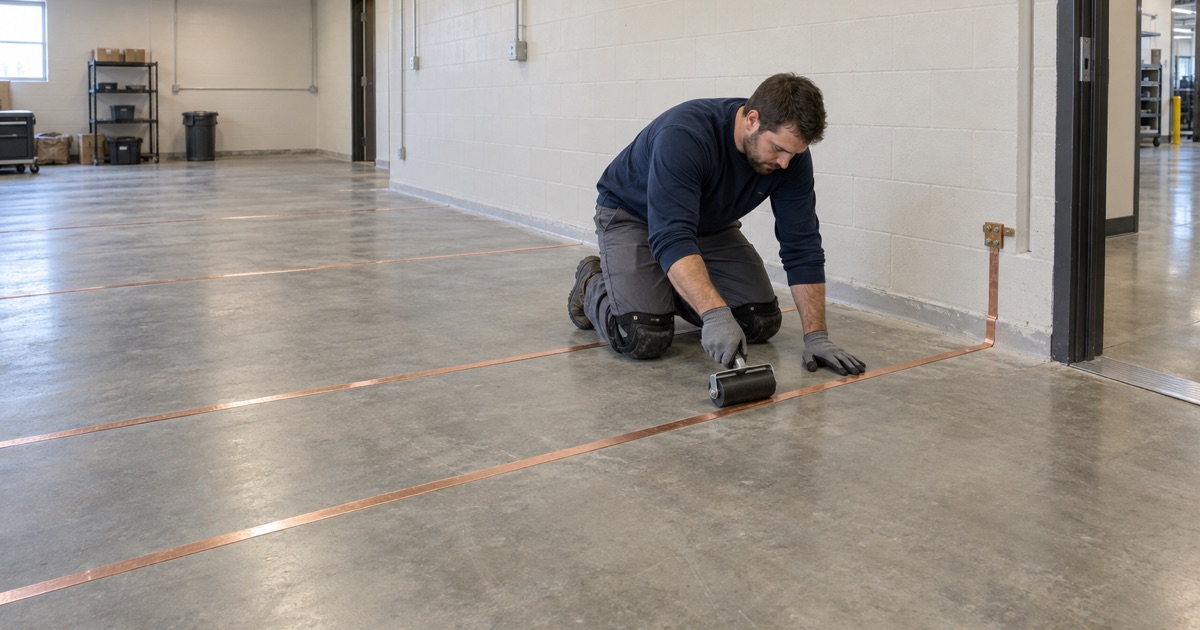
Most ESD systems use a conductive primer or a grid of conductive tape or copper strips beneath the topcoat, tied to building ground at set locations. These grounding points are planned on a drawing and installed before the finish coats.
The topcoat is formulated to carry charge from the surface down to that layer. Its thickness and the product used affect resistance, so we apply it to the manufacturer’s specified thickness and record it in the proposal and the job records.
Choosing the Finish Coat
ESD finish coats are available in epoxy and other resins and in a limited range of colors, often with visible conductive fibers. They can be combined with safety markings, aisle lines and zones that define protected areas.
Where an area sees chemicals, heavy carts or frequent washing, we discuss the tradeoffs between chemical resistance, wear and electrical performance with you, because the most durable finish is not always the right electrical match.
Testing and Verification
Resistance Testing at Handover
After the system has cured, we test the floor’s resistance at multiple points using the method your program specifies. The results are recorded with locations, so you have a baseline for future testing and audits.
If an area reads outside the range, we investigate before handover. Common causes include a missed grounding connection, contamination on the surface or a coating applied outside its specified thickness.
Keeping the Floor Within Range
ESD floors can drift out of range when they are waxed, cleaned with the wrong products or covered with mats and finishes that insulate them. Dirt buildup can also affect readings.
We leave written care instructions listing approved cleaners and practices to avoid. Routine testing, set by your static control program, catches changes before they become product problems.
Where ESD Floors Are Used
Electronics Assembly and Testing
Electronics manufacturing, repair and testing areas are the most common users of ESD floors. Components can be damaged by discharges too small to feel, so the floor is one of several controls that keep charge from building on people and carts.
We plan these installations around production schedules, phasing work by area and using overnight or weekend windows so lines can keep running elsewhere in the building. Each phase is tested before production moves back onto it.
Server Rooms, Labs and Control Rooms
Server rooms, network closets, instrumentation labs and control rooms also use static control floors. In these spaces, the floor must support raised equipment loads, rolling racks and frequent foot traffic while staying within its electrical range.
We coordinate access, ventilation and dust control carefully in spaces with sensitive equipment, isolating the work area and capturing grinding dust at the machine so it does not reach electronics nearby.
Proposals, Records and Repairs
The proposal names the system, the products, the grounding layout and the finished thickness, so the installed floor can be checked against the specification. At handover you receive the resistance test results and a drawing showing where the grounding points connect to building ground.
If an ESD floor is later damaged by a dropped part or a forklift gouge, it can usually be repaired locally with compatible conductive materials and retested. Using an ordinary patching product would leave an insulated spot, so repairs should always be made with the same system family.
- 20+ Years on Concrete
- Moisture Tested First
- Written Contracts