
Racine Epoxy Flooring applies polyaspartic floor coating in Racine, WI, serving surrounding cities including Mount Pleasant, Sturtevant, Caledonia, Somers and Kenosha, as part of more than 20 years spent on concrete floors. Polyaspartic is the coating we reach for when a floor sees sunlight, needs to return to service fast, or has to be coated in cooler weather than an epoxy would tolerate.
It is also a product that gets oversold. One-day floors are real, but the speed comes from the chemistry, not from skipping preparation. A fast coating laid on an unground, untested slab fails just as fast. We use polyaspartic where it solves a problem, and we build it on the same ground, tested concrete as every other system we install.
This page explains what polyaspartic is, where it earns its place on a Racine floor, how we build a polyaspartic system, and the questions worth asking about any one-day floor offer before you sign.
What Polyaspartic Coating Is
A Faster Relative of Polyurea
Polyaspartic is a type of aliphatic polyurea. Its chemistry gives installers a usable working window while still curing far faster than epoxy, which is why it has become common for garage topcoats and full one-day systems. Many products cure enough for foot traffic within hours.
Being aliphatic, it also resists the ultraviolet yellowing that affects most epoxies. That is the main reason we use it as the clear topcoat over flake and metallic floors: the color you choose stays the color you have, even near an open overhead door.
Strengths Compared With Epoxy
Compared with a standard epoxy finish, a polyaspartic topcoat is more resistant to abrasion, scratching, road chemicals and tire staining. It stays clear in sunlight and holds its gloss longer under traffic. It also tolerates a wider temperature range during application.
Epoxy still has strengths of its own. A 100% solids epoxy builds thickness economically, bonds very well to ground concrete and has a longer working time, which helps with metallic effects and large pours. That is why the strongest systems often pair the two rather than choosing one.
The Limits of Fast Cure
Fast cure has a cost: a short pot life. Once mixed, polyaspartic has to be spread and rolled quickly, and a crew working too large an area at once leaves lap lines and thin spots. We size batches to the crew and the floor, which is one of the reasons experience matters more with this coating than with slower ones.
Fast cure also does not make a damp slab dry or a contaminated slab clean. If moisture readings are high, a moisture-mitigation primer goes down first, and that primer has its own cure time. A schedule that promises one day before testing the slab is a schedule written before anyone knew the floor.
Where Polyaspartic Earns Its Place
Garage Topcoats That Hold Their Color
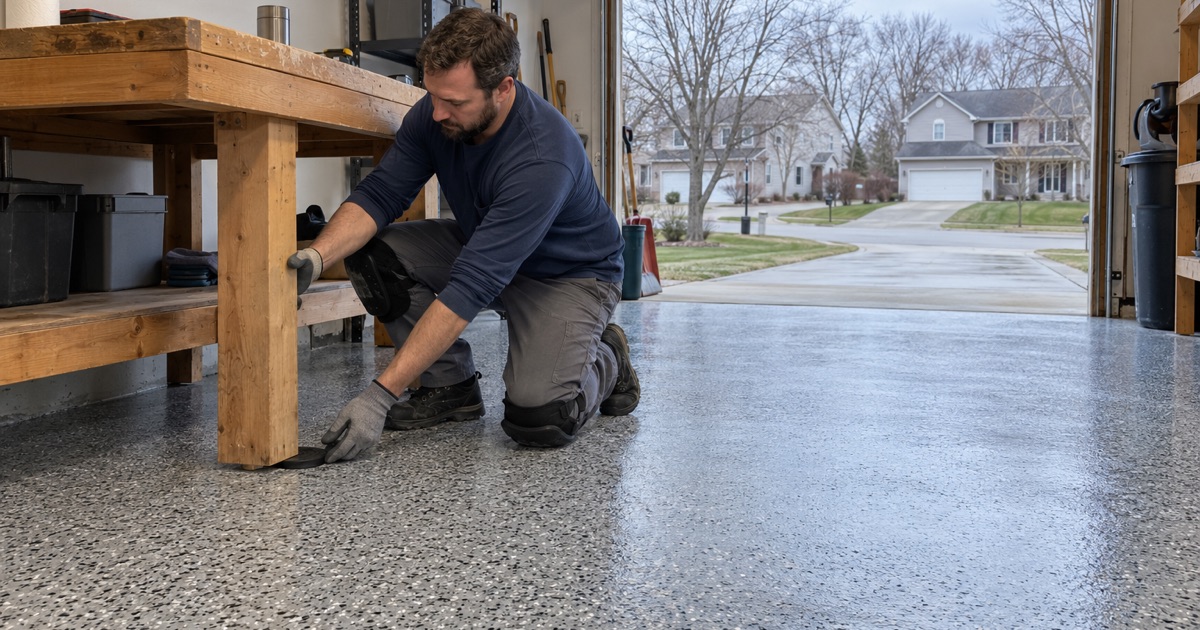
In a garage, polyaspartic usually goes on as the clear coat over an epoxy base and a vinyl flake broadcast. It locks the flake in, resists the gasoline, oil and brine that come in on the cars, and stays clear rather than yellowing in the sunlight that pours in every time the door goes up.
It also resists the brown staining some tires leave behind and the hot tire pickup that lifts weaker coatings. We build the topcoat to a thickness that will survive years of tire paths rather than a single thin coat stretched to save material.
Coating Cooler Slabs
Most epoxies slow sharply in cool conditions, and Racine’s long-term normals put the median last spring freeze around April 20. Polyaspartic cures at lower temperatures, which lets us coat a cool, attached garage or a shop slab in early spring or late fall when an epoxy job would have to wait.
That is not a license to coat anything at any time. We still schedule against the slab temperature and the dew point spread at the surface, and an unheated garage on a frozen slab still waits for spring. Polyaspartic widens the window; it does not remove it.
Businesses That Need the Floor Back
For retail backrooms, auto service bays, clinics and offices, downtime is a cost even when it is not on the invoice. A polyaspartic system can often be installed overnight or over a weekend and opened to traffic soon after, which keeps a business running while its floor is renewed.
We plan those jobs around the hours the building has to stay open, phase large floors by area and choose lower-odor products where staff or customers will be nearby. The schedule, the phasing and the return-to-service time go into the proposal in writing.
Building a Polyaspartic Floor System
Grinding and Priming the Slab
No coating, however fast, bonds to a slab that has not been opened. We diamond grind or shot blast every floor to an ICRI concrete surface profile suited to the system, removing laitance, sealers and contamination. We never acid etch, because an etched surface is weak and uneven exactly where the bond has to be strongest.
Once the floor is ground, we test it for moisture with ASTM F2170 in-situ probes or an ASTM F1869 calcium chloride test, and choose a primer to match the result. Cracks and spalls are filled during this stage, so the finished floor reads as one continuous surface.
Base Coats, Flake and Topcoats
On a typical garage, the build is a primer or epoxy base, a full broadcast of vinyl flake, and one or two polyaspartic topcoats. On a commercial floor that needs grip, quartz aggregate can replace the flake. Where speed matters most, the base can also be polyaspartic so the whole floor cures quickly.
The proposal names each layer, the product used for it and the finished thickness of the system. That way, what was quoted can be checked against what was installed, and two competing quotes can be compared layer by layer instead of by brand name alone.
Finish, Texture and Sheen
Polyaspartic topcoats come in gloss and satin, and both can take a fine anti-slip additive. In a garage, the flake itself provides some grip; at the apron, steps and around floor drains, we often add texture to the final coat for wet-weather traction.
A satin finish hides dust and fine scratches better, while gloss shows off a metallic or flake floor. We bring sample boards so you can see both on the color you choose under your own lighting before deciding.
Questions to Ask About a One-Day Floor
Has the Slab Been Tested for Moisture?
Fast coatings are often sold on speed alone, and moisture is the step most likely to be skipped. Wisconsin does not require a vapor retarder under an unconditioned attached garage slab, so a floor that looks dry may still have vapor rising through it. A coating trapped over that vapor can blister or peel within a season.
Ask whether the quote includes a moisture test and what happens if the reading comes back high. Ours does, and the answer is a moisture-mitigation primer priced as its own line before any topcoat goes down.
How Thick Is the Finished System?
A one-day floor can be a robust multi-layer system or a single thin coat. Ask for the finished thickness in writing, and ask which layers are included. A thin coat with a light flake scatter costs less but has far less protection against tires, dropped tools and winter salt.
We write the system build and thickness into the contract, along with the products, before taking a deposit, as Wisconsin’s ATCP 110 home improvement rule requires for home jobs. If anything about the build changes after testing, the contract changes with it before work starts.
What Does the Warranty Exclude?
A long warranty is worth reading closely. Nearly all coating warranties exclude failure caused by moisture vapor or hydrostatic pressure, and many exclude chemical damage and impact. We read those exclusions out before the job is sold, with moisture named first, so the warranty you rely on is the warranty you actually have.
- 20+ Years on Concrete
- Moisture Tested First
- Written Contracts