Racine Epoxy Flooring installs industrial epoxy flooring in Racine, WI, serving surrounding cities including Mount Pleasant, Sturtevant, Caledonia, Somers and Kenosha, for plants, warehouses, distribution centers and shops where the floor is a working surface. Forklifts, pallet jacks, oils, coolants, cleaning chemicals and dropped parts all test a coating in ways a residential garage never will.
Over more than 20 years, we have learned that industrial floors rarely fail in the middle of an aisle. They fail at joints, around machines, at dock doors and where chemicals pool. Our proposals address each of those zones specifically, and the schedule is built around the hours your plant has to keep running.
Systems for Plant and Warehouse Floors
High-Build Epoxy and Novolac Coatings
For most warehouse and assembly floors, we use a 100% solids epoxy system built to a specified thickness, with a topcoat suited to the traffic and chemicals. Broadcast layers of quartz or aggregate can be added where impact resistance or slip resistance is needed.
Where floors see stronger acids, solvents or concentrated cleaning chemicals, a novolac epoxy offers greater chemical resistance than standard epoxy. We select the resin based on the actual chemicals used in your process rather than a generic recommendation.
Trowel-Applied Mortars and Urethane Cement
Areas with heavy impact, steel wheels or thermal shock need more than a coating. Trowel-applied epoxy mortars build a thick, dense surface that resists gouging and can also rebuild damaged concrete. Urethane cement handles hot washdown, steam and temperature swings that would delaminate ordinary epoxy.
Many plants use several systems in different zones: a high-build coating in aisles, a mortar at loading docks and a urethane cement in washdown areas. We map those zones on a floor plan with you before pricing.
Specifying Thickness by Area
The proposal names each system, the product and the finished thickness for each area of the floor. That makes it possible to compare quotes on equal terms and to check later that what was installed matches what was bought.
We also note where the system changes, such as at transitions between aisles and process areas, and how those edges will be terminated so they do not become weak points under traffic.
Forklifts, Joints and Impact
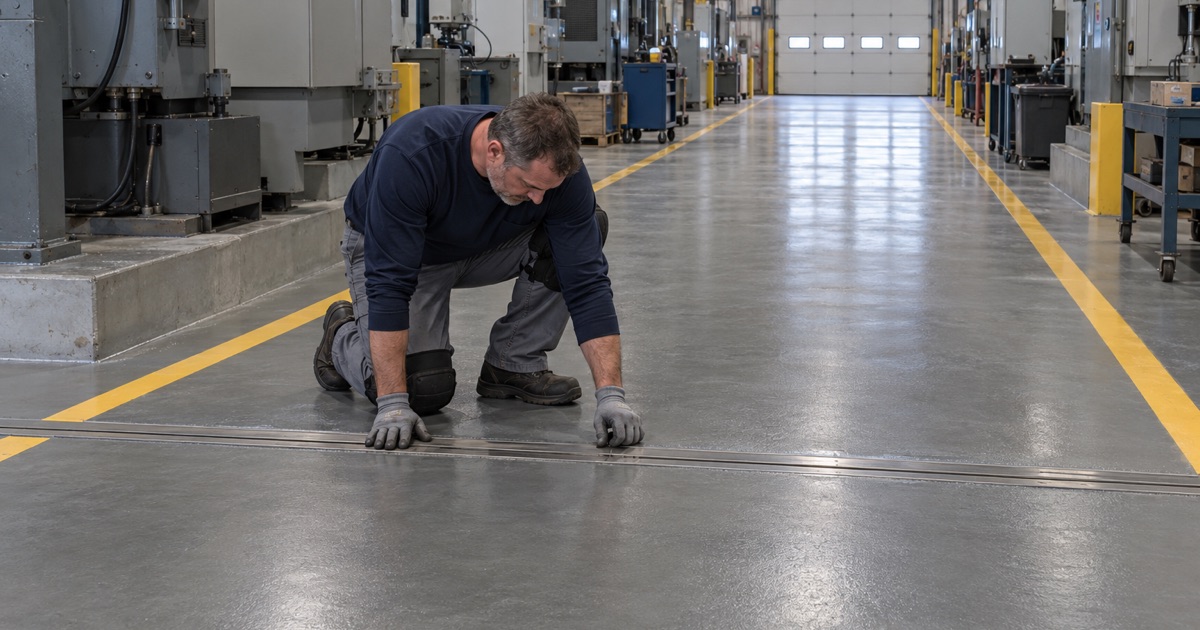
Filling Joints Before Wheels Cross Them
Every joint a forklift or pallet jack crosses is cleaned out and filled with a semirigid joint filler before any coating goes over it. Hard wheels hitting an open joint chip its edges, and a coating bridged over an unfilled joint cracks along the line.
Where the slab is still moving, the filler may need periodic maintenance. We point those joints out at handover so your maintenance team knows what to watch.
Dock Doors, Ramps and Impact Zones
Loading docks take snow, salt and meltwater from trucks in winter, along with heavy impact from loaded pallets and dock plates. We often use thicker mortar systems or broadcast layers at the dock line, carried far enough into the building to cover the wet zone.
Ramps and transitions get textured finishes for traction. Areas around machines that see dropped parts or heavy tooling get an impact-resistant build rather than a thin coating that will chip on the first drop.
Chemicals, Oil and Process Fluids
Matching Resin to the Chemical List
Chemical resistance depends on what spills, how long it sits and how hot it is. We ask for your list of process chemicals, cleaners and fluids, then compare them with manufacturer resistance data for the systems we are considering.
Where a single area handles particularly aggressive chemicals, we may specify a different system there rather than over-specifying the whole floor. That keeps the cost focused where protection matters most.
Oil-Soaked Slabs and Machine Areas
Older plants often have years of oil and coolant soaked into the concrete around machines. Coatings will not bond over that contamination. We degrease, grind through stained concrete and test adhesion before coating.
Where contamination is too deep to remove, we discuss options such as cutting out and replacing sections of slab or using primers designed for oil-tolerant bonding, and we say plainly which approach is realistic.
Washdown Areas and Floor Drains
Process areas that are hosed down every shift need a floor that slopes to its drains and seals tightly to them. Water that gets under a coating at a drain body spreads beneath the system and lifts it from below. We preserve or correct the slope and terminate the system into each drain with a sealed edge.
Where hot water or steam is used for cleaning, ordinary epoxy can soften and debond. Those zones usually get urethane cement, which tolerates thermal shock, carried up the walls in a cove so washdown water cannot reach the joint between floor and wall.
Shutdowns, Safety and Site Control
Working Within Shutdown Windows
Industrial floors are scheduled around production. We plan around holiday shutdowns, weekend windows and overnight shifts, sequencing areas so the plant keeps operating elsewhere. Fast-curing systems help when the window is tight.
The sequence, cure times and return-to-service dates are written into the proposal. If moisture testing or slab conditions change the plan, we tell you before work starts rather than midway through a shutdown.
Safety Markings, Dust and Slurry
Aisle lines, pedestrian walkways, hazard zones and equipment outlines can be built into the floor with the topcoat, so they last as long as the system. Slip-resistant texture can be added in wet areas and along walkways.
Grinding dust is captured at the machine with industrial vacuums, and slurry is collected on site and hauled away rather than washed toward a drain. In plants with food, electronics or clean processes, we isolate the work area to protect production nearby.
- 20+ Years on Concrete
- Moisture Tested First
- Written Contracts