Racine Epoxy Flooring installs metallic epoxy floors in Racine, WI, serving surrounding cities including Mount Pleasant, Sturtevant, Caledonia, Somers and Kenosha, with the same ground-and-tested slab preparation we have relied on for more than 20 years. A metallic floor is the most visually striking coating we install, and it is also the least forgiving of shortcuts.
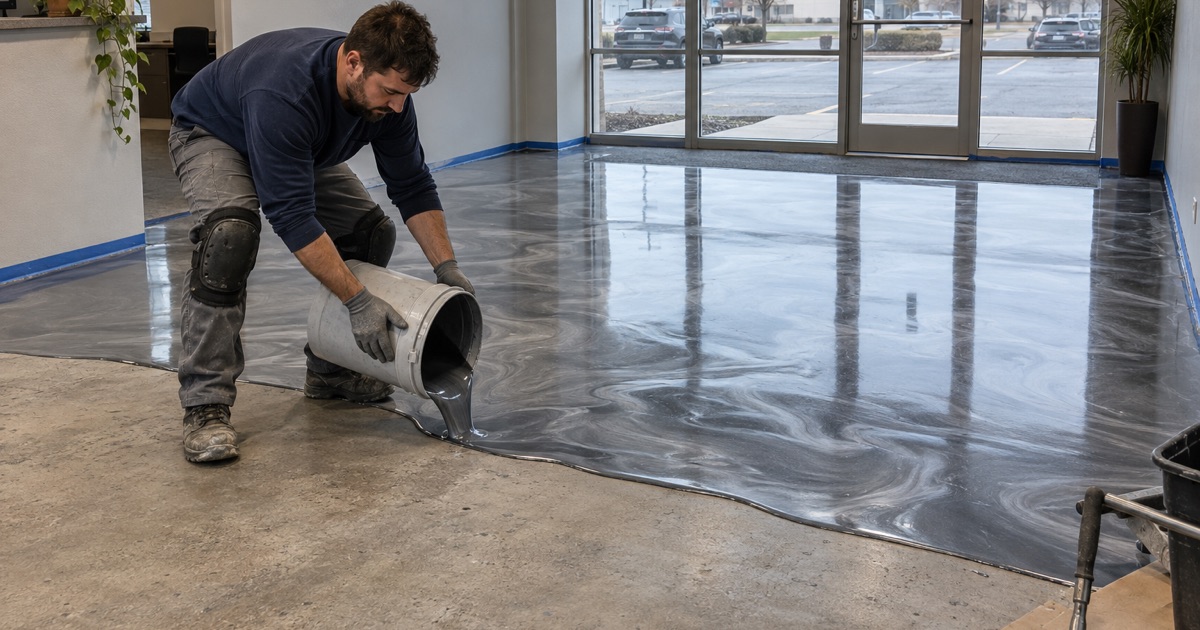
The effect comes from metallic pigments suspended in clear epoxy. As the resin flows and cures, the pigments drift, swirl and settle, leaving a marbled surface with a sense of depth that looks like polished stone, molten metal or water depending on the colors and technique. No two floors repeat.
Below we explain where a metallic floor works best, how we prepare the slab for it, how the pour is built, and how to keep the finish looking good. If you are weighing metallic against flake or polished concrete, the comparison is in here too.
Where a Metallic Floor Fits
Basements, Bars and Family Rooms
Finished basements are a natural home for metallic epoxy. The floor is protected from sunlight and heavy vehicle traffic, and a marbled finish can make a lower level feel like part of the house rather than a utility space. Bars, media rooms and game rooms benefit most from the depth and reflection.
Because a basement slab sits below grade, moisture testing comes first. A metallic pour is thin, glossy and continuous, so a blister caused by rising vapor would be obvious. When readings are high, a moisture-mitigation primer goes down before any color.
Showrooms, Offices and Retail Spaces
In showrooms, salons, offices and boutique retail, a metallic floor becomes part of the brand. Colors can match a logo or interior palette, and the reflective finish brightens the space under display lighting. Many commercial owners also value that the seamless surface cleans quickly with a mop or auto scrubber.
Commercial metallic floors are usually installed after hours or over a weekend, phased so the business can stay open. We plan the cure times and the topcoat so the floor is ready for foot traffic when the doors open again.
Display Garages, With Caveats
Some owners want a metallic floor in a garage that houses a collector car or doubles as a hobby space. It can look spectacular there, and a polyaspartic topcoat gives it real wear resistance. But metallic finishes show dust, scratches and tire marks more readily than flake.
For a garage that sees daily driving and a Racine winter of brine and rock salt, we usually recommend a flake system instead. If you want metallic anyway, we will build it with a thick topcoat and explain honestly how it will age.
Preparing the Slab for a Metallic Pour
Grinding Flat, Not Just Rough
Every coating we install starts with mechanical grinding, never acid etching. For metallic floors, grinding has a second job: making the slab as flat and uniform as possible. A thin, flowing pour will reveal ridges, trowel marks and old patch lines that a flake floor would hide.
We grind to an ICRI concrete surface profile suitable for the primer, then check the floor under raking light to find low spots and lips. The grinder’s dust collection captures concrete dust at the machine, keeping the rest of the building clean.
Repairs, Joints and Feathering
Cracks and spalls are filled with repair resin and ground flush, then feathered so the edge disappears. Control joints are either filled or honored as deliberate lines, depending on whether the slab is still moving. A moving joint filled solid will crack through a metallic finish, so we read the slab before deciding.
Old adhesive, paint and coatings are removed completely. Any residue left under a metallic pour can create a dull patch, a fish-eye or a bond failure, all of which are far more visible on a metallic floor than on a textured one.
Moisture and Temperature Checks
Before any color goes down, we test the slab for moisture using in-situ relative humidity probes to ASTM F2170 or a calcium chloride test to ASTM F1869. We also check the slab temperature and the dew point spread at the surface, because condensation or amine blush between coats can spoil the finish.
Metallic epoxy needs a stable environment to flow evenly. Temperature swings during the pour change how the resin moves and where the pigment settles, so we control the space and schedule against conditions rather than the calendar.
Building the Metallic Layers
Primer and Tinted Base Coat
After priming, we apply a tinted base coat. Its color affects the final look, because the metallic layer is partly translucent and the base shows through in the thinner areas. A dark base deepens the contrast; a light base makes the floor brighter and softer.
The base also gives the metallic pour a smooth, uniform surface to flow over. Any pinholes from outgassing concrete are filled at this stage, so air does not rise into the metallic layer and leave bubbles.
Pouring and Working the Metallic Coat
The metallic coat is a 100% solids epoxy mixed with metallic pigments and poured across the floor. Installers then work it with rollers, trowels, brushes or sprays of solvent to create movement, veining and cells. The working time is limited, so the crew has to move quickly and consistently.
This is where experience shows. Two crews can use the same product and produce very different floors. We discuss the look you want, show samples and plan the technique before the pour rather than improvising on your floor.
Topcoats for Wear and Sunlight
Once the metallic layer cures, we protect it with a clear topcoat, usually a polyaspartic or polyurea. That topcoat resists scratches, chemicals and ultraviolet ambering much better than bare epoxy. In bright rooms or near overhead doors, it is essential to keep the colors true.
Sheen is a design choice. High gloss maximizes depth and reflection; satin softens glare and hides fine scratches and dust. We can also add a fine anti-slip texture in areas that may get wet.
Living With a Metallic Floor
Cleaning and Everyday Care
A metallic floor cleans easily with a dust mop and a pH-neutral cleaner. Grit is the main enemy, because it scratches the topcoat over time. Mats at entrances, felt pads under furniture and prompt cleanup of spills keep the finish looking new.
Avoid harsh chemicals, abrasive pads and dragging heavy objects across the floor. If the topcoat dulls in high-traffic paths after years of use, it can be lightly abraded and recoated without disturbing the metallic layer underneath.
Comparing Metallic, Flake and Polished Concrete
Metallic offers the most dramatic look but shows wear more readily. Flake is more forgiving, hides dirt and offers more texture, which suits working garages and laundry rooms. Polished concrete has no coating to peel and handles some slab moisture, but it shows every patch and stain in the slab.
We help you choose based on how the room is used rather than on photos alone. Often the right answer is metallic in the finished room and flake in the garage or utility space next door.
Proposals and Warranty Terms
Our proposal names every layer of a metallic system, the product used and the finished thickness, so what was quoted can be checked against what was installed. Home jobs get a written contract before any deposit, as Wisconsin’s ATCP 110 home improvement rule requires.
We read warranty exclusions out before the job is sold, starting with moisture. On a glossy metallic floor, a failure from rising vapor would be impossible to miss, which is why testing comes before the color conversation.
- 20+ Years on Concrete
- Moisture Tested First
- Written Contracts