
Racine Epoxy Flooring polishes concrete floors in Racine, WI and in surrounding cities including Mount Pleasant, Sturtevant, Caledonia, Somers and Kenosha, drawing on more than 20 years of grinding and finishing concrete. A polished floor is not a coating laid on the slab. It is the slab itself, ground flat, hardened and refined until it reflects light.
That makes polished concrete a very different decision from an epoxy system. Nothing sits on top to peel, scratch through or delaminate, and the floor can let moisture vapor pass instead of trapping it. In exchange, the slab you have is the canvas you get: its stone, its patches and its history all show in the finish.
The sections below cover how a floor gets polished, how to choose a look the slab can actually deliver, and where polished concrete works best in commercial and residential spaces around Racine. We grind a sample area on most jobs, so the decision rests on your own concrete rather than a brochure.
How Concrete Gets Polished
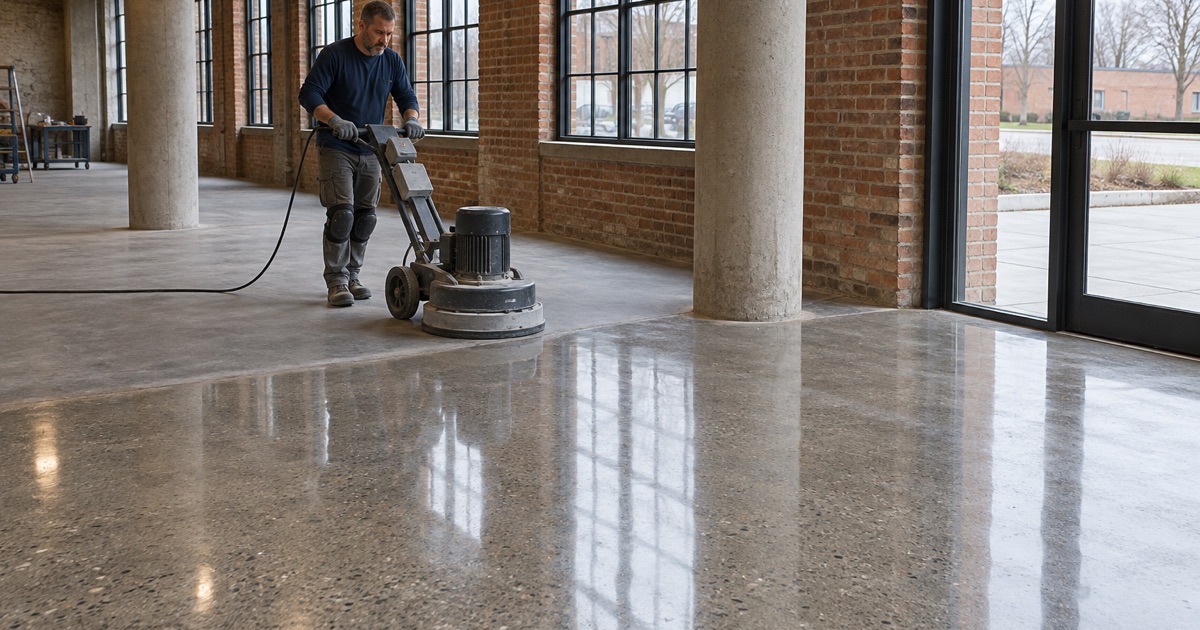
Grinding Through Progressive Diamonds
Polishing starts with metal-bond diamonds that flatten the slab and cut to the depth that sets the final look. From there we step through finer and finer tooling, each pass removing the scratches left by the one before. Skipping a step saves time on the day and leaves swirl marks that show under store lighting.
The number of passes depends on the slab and the sheen you want. A soft or uneven floor may need more coarse grinding to reach sound concrete, while a newer, flat slab can move to the finer steps sooner. We tell you which kind of slab you have after the first passes, not before.
Hardening With a Lithium Silicate Densifier
Partway through the grinding sequence, we apply a lithium silicate densifier. It soaks into the opened surface and reacts with the concrete to harden the top layer, which makes it more resistant to abrasion and helps it take a higher polish.
Densifying also reduces the dusting that bare concrete produces under traffic, which matters in warehouses and shops where fine concrete dust settles on stock and machines. Timing matters: applied too early or too late in the sequence, the densifier does less good.
Guard Coats and Sheen Levels
After the final polishing step, we usually burnish in a penetrating guard that helps the surface resist stains from oil, coffee and cleaning chemicals. It is not a thick film, and it does not stop the slab from breathing the way a coating would.
Sheen is set by how far the polishing sequence goes. A satin finish suits warehouses and garages where a bright reflection would show every tire mark. A higher gloss suits retail floors and lobbies where reflected light brightens the room and makes the space feel larger.
Choosing the Look Your Slab Can Give
Cream, Salt and Pepper or Exposed Aggregate
How deep we grind decides how much stone you see. A cream polish stays near the surface and shows little or no aggregate. A salt and pepper finish cuts slightly deeper to reveal fine sand and small stone. Full exposure grinds into the larger aggregate for a terrazzo-like look.
Deeper exposure takes more grinding, and the result depends on how evenly the stone sits in your slab. Some floors show stone uniformly, and others show patches of deep aggregate next to areas of cream. A test area shows which kind you have before the whole floor is committed.
Dyes and Color on Polished Floors
Concrete dyes can tint a polished floor in shades from soft gray to deep brown or charcoal. Dye goes in after grinding and before densifying, so it penetrates the concrete rather than sitting on top. Color can also be used to define walkways, departments or a logo at an entrance.
Dye works with the slab rather than covering it, so variation in the concrete shows through as variation in color. Many owners like that natural, mottled look. If you need a perfectly uniform color, a resin coating is usually the better route.
What Every Slab Brings to the Finish
Patches, saw cuts, old adhesive, deep oil stains and repaired cracks all show in a polished floor. Grinding can remove surface staining, but contamination that soaked deep into the concrete may remain visible. We look for those before quoting and tell you what will likely show.
Cracks can be filled with a color-matched filler, but they remain visible as lines. Some owners treat them as part of an industrial look. If a clean, uniform appearance matters more than the character of the slab, we will say so and talk about a coating instead.
Commercial Polished Concrete Floors
Warehouses, Retail Stores and Showrooms
Polished concrete is common in warehouses, big-box stores, showrooms and offices because it is hard-wearing, bright and simple to clean. The densified surface stands up to pallet jacks and foot traffic, and a reflective finish can make a large space feel lighter.
For stores and showrooms we usually aim for a higher sheen, while working warehouses get a satin finish that hides tire marks. In either case we plan the work around the hours the building has to keep running, phasing by aisle and working overnight or over weekends where needed.
Joints, Forklifts and Edge Protection
In a warehouse, the joints matter as much as the polish. Before or during polishing, we fill control and construction joints with a semirigid joint filler that supports the edges, so forklift wheels do not chip the concrete along the joint lines.
Where a joint is still moving with the slab, the filler may need periodic touch-up. We point those out at handover so maintenance staff know what to watch rather than discovering spalled joints a year later.
Maintaining a Commercial Polished Floor
A polished floor is cleaned with an auto scrubber and a pH-neutral cleaner, with periodic burnishing to restore sheen in high-traffic lanes. It does not need stripping and rewaxing, which is often a large part of the maintenance budget on a vinyl tile floor.
When a lane eventually dulls, it can be refreshed with a light repolish of that area rather than the whole floor. We leave a written cleaning guide so the floor gets the same care whoever is running the scrubber.
Residential Polished Concrete Floors
Basements and Lower Levels
In a basement, polished concrete has one real advantage over a coating: nothing sits on top for moisture vapor to push off. A slab that breathes a little can still take a polish. We still test first, because standing water or hydrostatic pressure is a drainage problem no finish will fix.
The tradeoffs are comfort and appearance. Concrete stays cool, so area rugs are common in living spaces. And older basement slabs often carry patches and uneven troweling, so we grind a sample area to see whether the result fits the room you have in mind.
Living Spaces, Additions and New Slabs
For a new addition or a home built on a slab, polished concrete can be planned from the pour: the finish, the aggregate and the joints can all be chosen with polishing in mind. That gives the most predictable result and the widest choice of looks.
On an existing floor, we work with what is there. Removing old flooring often leaves adhesive and thinset that must be ground away, and tack strip holes or plumbing patches will show. We walk through those details at the estimate so the finished floor matches expectations.
- 20+ Years on Concrete
- Moisture Tested First
- Written Contracts